Next deployment: TBD

This post is by Missing in the Mission blogger Suguru Mizunoya. 

Look and listen for the welfare of the whole people and have always in view not only the present but also the coming generations, even those whose faces are yet beneath the surface of the ground – the unborn of the future Nation.

 The Great Binding Law, Iroquois Nations

“Voicing for the voiceless” is a phrase that I liked and used frequently during my service with UNICEF in Africa.  I was (and am) so proud to work for children.  I had been giving voice to children in developing countries in Africa and elsewhere, many of whom still suffer from lack of access to education, clean water, shelter, and nutrition. But I didn’t know that children in my own hometown in Fukushima, Japan, were also voiceless.  The day the Great East Japan Earthquake hit our hometown—and three nuclear power plants in Fukushima started to meltdown—they too needed a voice.

* * * *

March 11, 2011. Morning in Kenya. My mobile phone rang. But I turned it off, as I was working. It rang again. Again, I turned it off.

It was a nice morning in Nairobi, and I was attending a workshop. The workshop just started and I did not want to be distracted by a call. Then the phone rang a third time. Thinking it must be an emergency, I picked up. “Suguru, a huge earthquake has hit Japan. Somewhere in the north. My parents are away. I just opened all the doors of our house so that we won’t get stuck inside.”

It was my wife in Saitama prefecture in Japan. She delivered our baby boy four months ago and was staying in her parents’ home until the baby grew big enough to travel to Kenya, where I worked.

“I called your mom in Fukushima. I was able to talk with her once. She was fine. But I can’t reach her anymore. Something is wrong with the mobile communication system. I can’t call my mom, either. I am scared.”

I told my wife to stay at home and try to fill the bathtub, just to secure water. And try to collect more information. As soon as we hung up, I told my colleagues that I needed to Continue reading

On leaving work and wondering what to take away

This week’s blog is by Leora Ward, creator of Healing in Service. Leora has worked for many years in the social justice, women’s empowerment, and humanitarian fields.

As I leave my current job, after six years, it feels as if a phase of my life is closing. A circle is about to be completed, and I am left wondering what I should take away. What am I supposed to harvest from this season of my work in the humanitarian field?

This question has been cycling through my mind over the last few weeks. As I have written about it in my journal, talked about it with friends, and even listened to similar stories from other women in the social justice field, I have come up with three things that seem to continue to show up (for me and others) in our community.

DSC06757 (2)

FEELINGS OF OVERWHELM AND ISOLATION

Many of us feel overwhelmed by the scope and scale of need in the world, and the long-term vision required to fully achieve social justice. These feelings (and the associated grief) leave us discouraged, overworked, and isolated. The emotions can be so intense that we consistently feel like we are falling over and maybe flat onto our face. We also typically don’t have the networks or support we need to keep us healthy, grounded, and balanced in Continue reading

Being part of a humanitarian power couple: Lessons from the inside


This post is written by @josh_chaffin. The author did NOT choose the title of this post OR the photo, but indulged our aid worker sense of humor. 

One partner gets the job in a new country, the other stays flexible, comes along for the ride and makes it work. Repeat as necessary.

Be willing to have your partner disappear for a week or three weeks, a month or three months, all the time. Especially if one of you is consulting, which will usually be the case.  One year, before we had a kid, we were apart like 30% of the year.

But when you have a kid, suddenly the hardship posts and tons of travel for consulting are no longer possible. So you scramble to find two HQ or family duty posts and hold onto them for dear life. It’s not a family-friendly industry, or even a relationship-friendly industry. It’s littered with failed relationships and single people. You need to find a Continue reading

Hamster on a wheel

hamster

Familiar feeling?

I told my colleague today about starting this blog. She asked about how much time I’d taken off, what I’d done, when I’d started working again. We’ll get into that later. She also commented on how hard it is to change pace when one is used to working in high-adrenaline contexts: Before I left my country program, there were so many things to do each day I could never fit them all in–but if I didn’t get them done, there would be serious consequences. Now I look at my planner and it’s not even full.  I nodded. It reminded me of the hamster wheel.

When I first decided to leave work, someone who knew what they were talking about told me, Adrenaline is like a drug. You’ll need to wean your body off of it, because it’s addicted to adrenaline now. Your body will resist. But you’ll get through it.

She was right.

Six months later I was away from work, sitting on my couch, in the middle of winter, and I could FEEL my brain RUNNING. It felt like someone had opened my head, inserted a shiny metal wheel and then introduced a very fit and energetic hamster onto it. I wanted to fuel the hamster, I wanted to fill it up on news from Syria (my last deployment) and reports about ISIS taking Ar-Raqqah (near one of our health clinics) and ‘marching’ towards Iraq (the newest unfolding crisis in a long list of crises there) and long commentaries on the origins of ‘extremist groups’ and Facebook feeds from friends still working and living in the region and… you get the idea.

The hamster was burning up the wheel, running so fast that flames were practically Continue reading

On change

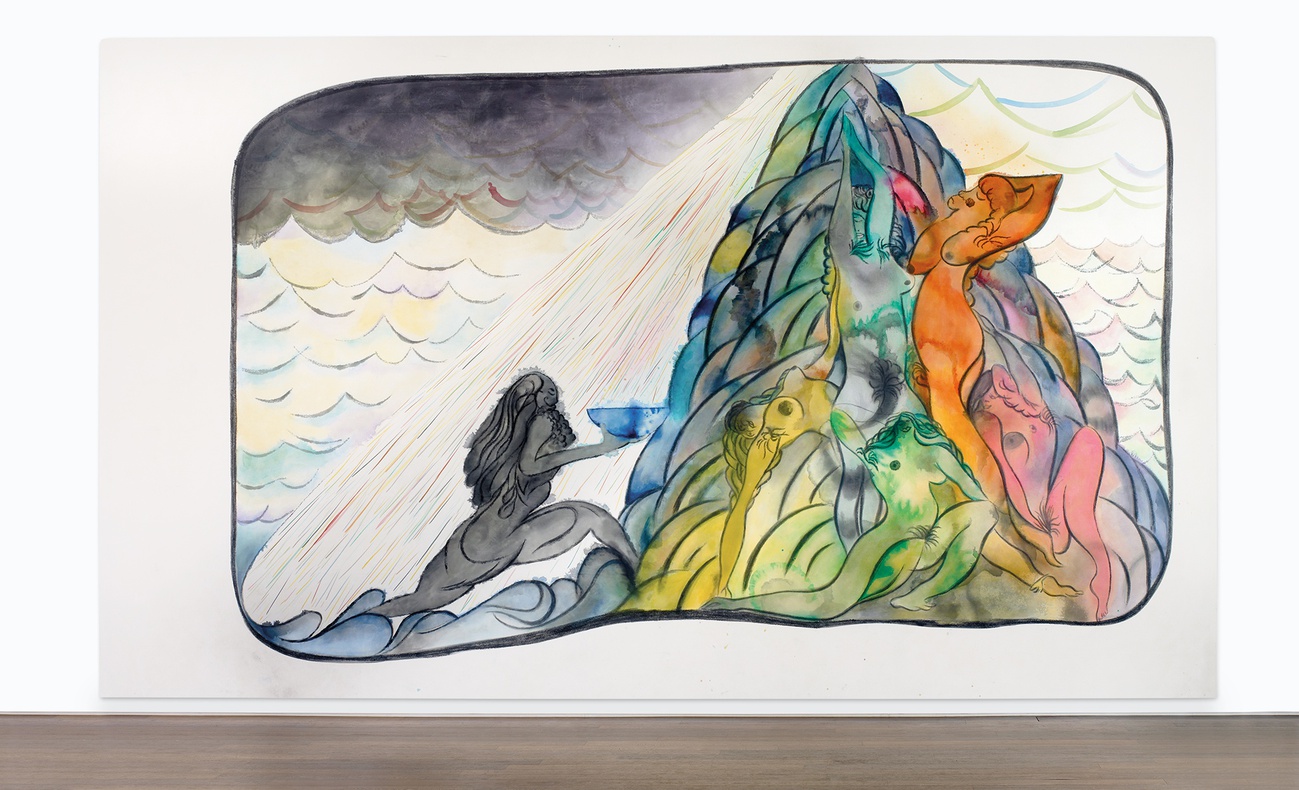
to take and to give, 2012. Acrylic on canvas, 519 x 880 cm. Artist: Chris Ofili. Source: http://www.victoria-miro.com/artists/6-chris-ofili/

Chris Ofili, painter, on moving from London to Trinidad:

I felt ready for the change to happen, and I knew it was happening inside me, he said, straining to be clear. It’s hard to go away from something that’s very enjoyable, and a domain where I felt supremely confident. Before, I was focussing on high impact, and what I wanted to find was less complex and maybe less visible.

Back from the borderlands

AM photo 1

This post is written by an anonymous contributor.

It is difficult to write about ending a mission while on mission. It is difficult to write about taking a break when the breaks one is able to take are too short to notice, too quick to be able to unwind. Working in isolated and dangerous locations takes a toll on a person’s body and mind. We come here to help people, but forget about taking care of ourselves.

I am guilty of this, of not making time to rest and re-energise. I think this is important, even in the midst of a demanding mission. It makes it easier for us to re-enter “normal” society after the mission is over, to meaningfully reconnect with those we love and who love us. I have been continuously working in so-called “deep field” locations for the pastseven years, with fluctuating levels of remoteness and insecurity. I count myself fortunate that only one person I care about was killed. I have had several friends kidnapped for Continue reading

Sea Change

SeaChange-Image-1

Source: MIT Water Club 

My father taught us very early on to respect the sea. As young girls, my sister and I would go into the water with him on an inflatable raft and learn to “catch” waves, to ride them into the shore. If we started paddling too late, we would miss the wave entirely; too soon, and it would break on top of us and sometimes throw us off the raft. We would go tumbling along on the sand under the water, forced to hold our breath until the wave let us come up for air again (getting “rolled”, as he called it). It was scary, but exhilarating.

Our most important lesson came on calm days, when he taught us not to mistake the smooth surface of the water and absence of waves for a lack of action underneath. Even when they are barely visible on the surface, there are always currents and sometimes a strong undertow. These powerful forces can carry us very far — in a direction that we may or may not want to go. And sometimes they act stealthily, taking us a ways down the shore before we even realize that we are being redirected.

When I first took a break from aid work, I felt burnt out and alone.  I started this blog in part to confront that stereotype, to respond to the many whispered conversations and questions of, “I feel like that too” and “But how did you do it?” and “Aren’t you scared you’ll never be able to go back?” I had seen a close colleague and friend, someone who I had long admired in the field, leave her job in a sudden and heartbreaking way. I supported her as best I could during her last few months at work, when she felt abandoned by the very entity that she had given so much to over the years. She eventually took the difficult and Continue reading

“Don’t be afraid of tearing it all down if you have to….”

I am about to turn 41 and would tell my 30 year old self that you do not have to conform you[r] life to an ideal that you do not believe in. Live your life, don’t let it live you.

Don’t be afraid of tearing it all down if you have to, you have the power to build it all back up again.

— Lisa, 41

Excerpt from: 10 Lessons That Will Help You Excel In Your 30s … or 40s, or 50s, or 60s, or…..

Sacrifice

This is in response to a blog prompt from The Daily Post to write about “Sacrifice.”

Prompted by the downward spiral of my country’s political process, I started binge-watching The West Wing again yesterday. I didn’t see it the first time around, when everyone was using Martin Sheen’s characterization of President Josiah Bartlet to escape the Bush presidency. It wasn’t until 2011 when, reeling from a few very personal losses, I took a leave of absence from my job and, instead of flying off to Chad as originally planned, moved into a studio apartment in the Lower East Side.

It was a sublet from a film accountant who had gone to Rhode Island to work on Moonrise Kingdom. Aside from being in enviably close proximity to Wes Anderson and his usual cast of characters, she had LOTS of DVDs–including the entire 7 seasons of The West Wing. As someone who doesn’t watch much TV,  I only made it to season 3 before moving out and Continue reading

Hot water

People are like tea bags.
You find out how strong
they are when you put
them in hot water.
-Anonymous

This tea-bag approach to what some might call resilience reminds me of what an old boss, the head of our agency’s programs in Darfur, called the problem of the “frog in boiling water.” He said that a frog can be immersed in a pot of water, and if that pot is put on a stove and the burner turned on, the frog won’t notice the gradual increase in temperature until it is too late; until she literally boils.

The metaphor may jump out (no pun intended) for some faster than others: when working in insecure environments, this was used to explain how at first something like a carjacking may cause all aid agencies to halt operations. As the frequency of such incidents increases, they become normalized to the point where a carjacking occurs and… activities go on as planned. Perhaps the incident is a footnote at the security briefing. Conversation fodder at Continue reading